Attalea butyraceae (Mutis ex L. f.) Wess. Boer
Syn. Scheelea rostrata (Oerst.) Burret.
Arecaceae
PALMA REAL, COROZO, ROOSTER-TAIL PALM
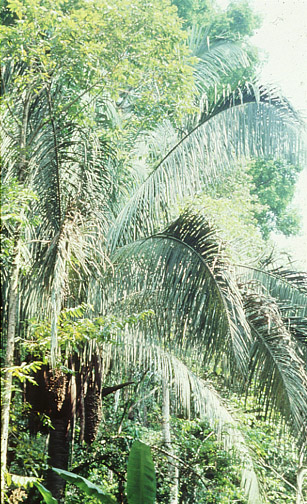
Common evergreen understory tree (10-15 m) that sometimes appears as a component of the lower layers of primary forest (e.g. Punta Catedral) but more often is located in sunnier areas where the vegetation has been disturbed (along trailsides, amid secondary forest). Palma Real leaves are oriented in a vertical (not horizontal) plane, and this unique feature helps to distinguish this species. Often a prolific producer of palm nuts, many mammals rely on Palma Real as one of their major sources of food during the early months of the wet season.
Description: Palma Real has a straight, cylindrical trunk (40 cm). Flaring slightly at it’s base to accommodate the emergence of many fibrous roots, the columnar bole maintains an otherwise uniform diameter. Smooth, spineless, and gray-brown in color, the palm’s surface is conspicuously marked by the wide, encircling, and periodic leaf scars typical of all Arecaceae.

The extremely large leaves (6 by 0.8 m) are confined to the pinnacle of the tree, and they emanate from a common locus where the growth-producing palm heart is found. Palma Real fronds are pinnately compound, and the numerous, dark-green, ribbon-like leaflets all lie within a single plane and are attached to a thick, dark-brown, petiole. More notable and distinguishing, however, is the manner in which these fronds are extended. Angled upwards, the plane containing the frond leaflets is vertically oriented. About 2/3 of the way from its point of attachment to the bole, the petiole weakens and bends, causing the distal portion of the frond to droop downward. Thus oriented, the Palma Real leaf bears a marked resemblance to the tail of a rooster (hence the English common name for this species). New foliage is produced continuously, with the folded frond spikes growing vertically from the top of the apical bud. As more leaves are formed, the older ones are gradually displaced laterally – pushed to the sides of the crown. Over time, the petioles are slowly rotate away from the tree’s apex. Before they become completely horizontal, the fronds die and fall from the tree.
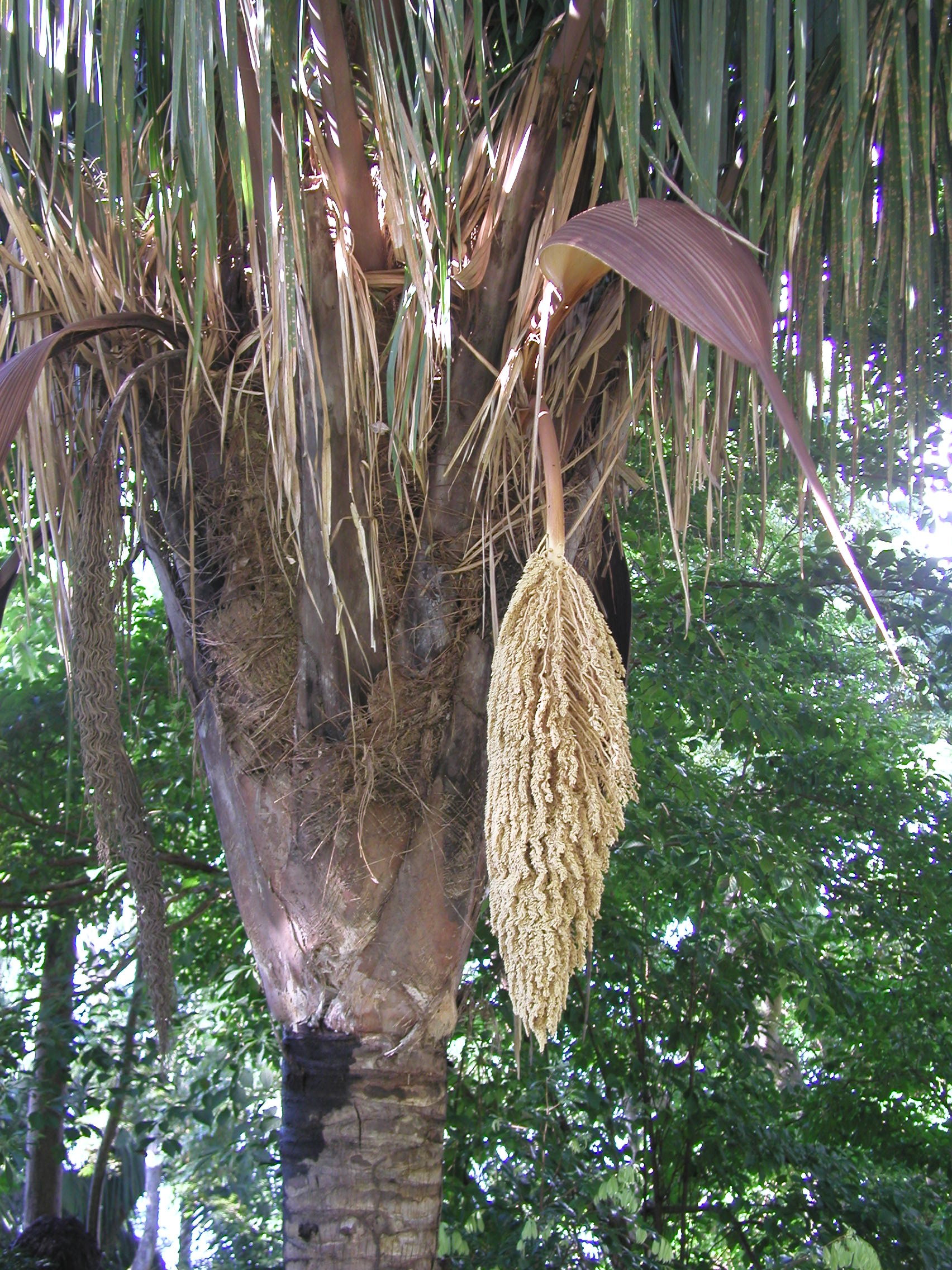
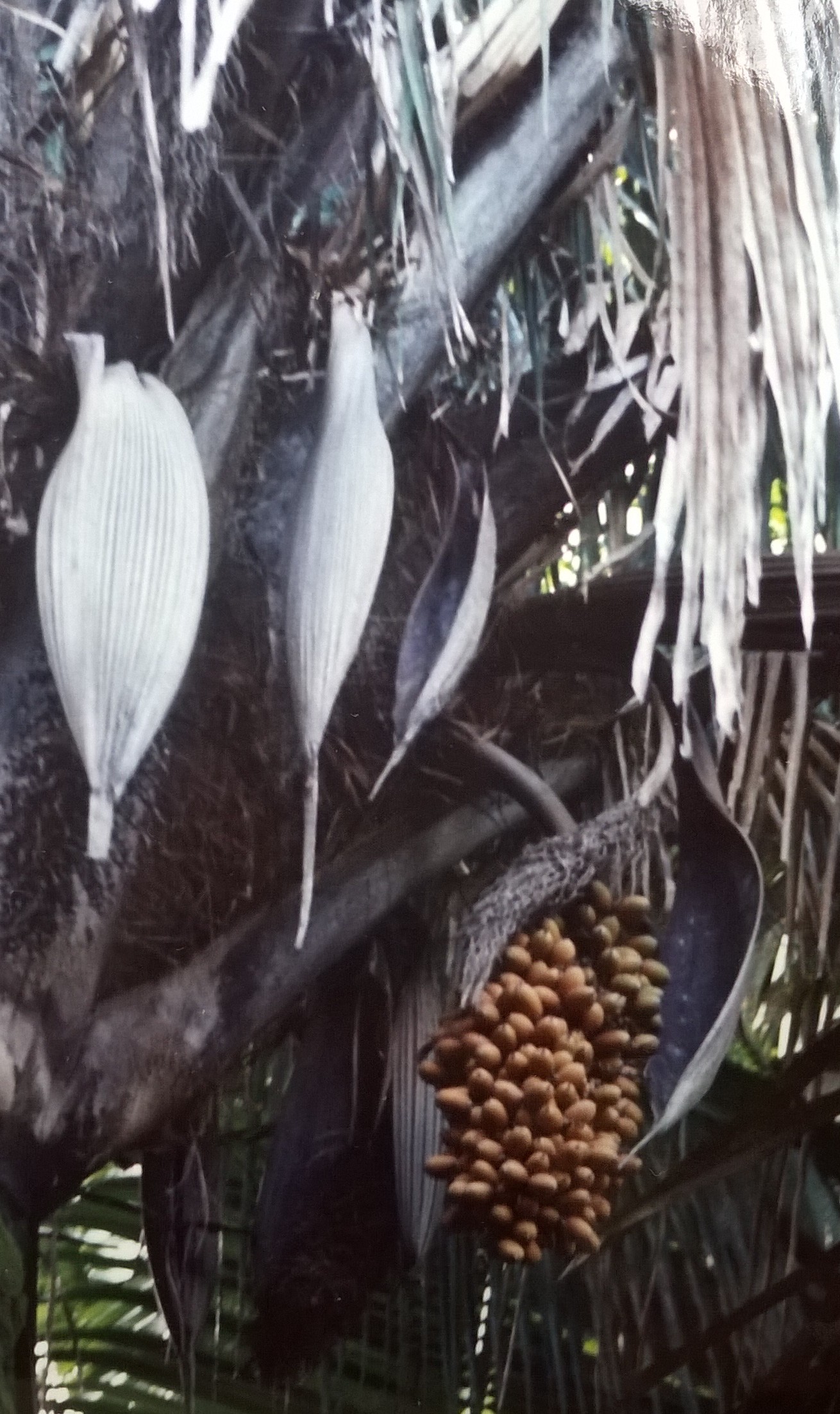
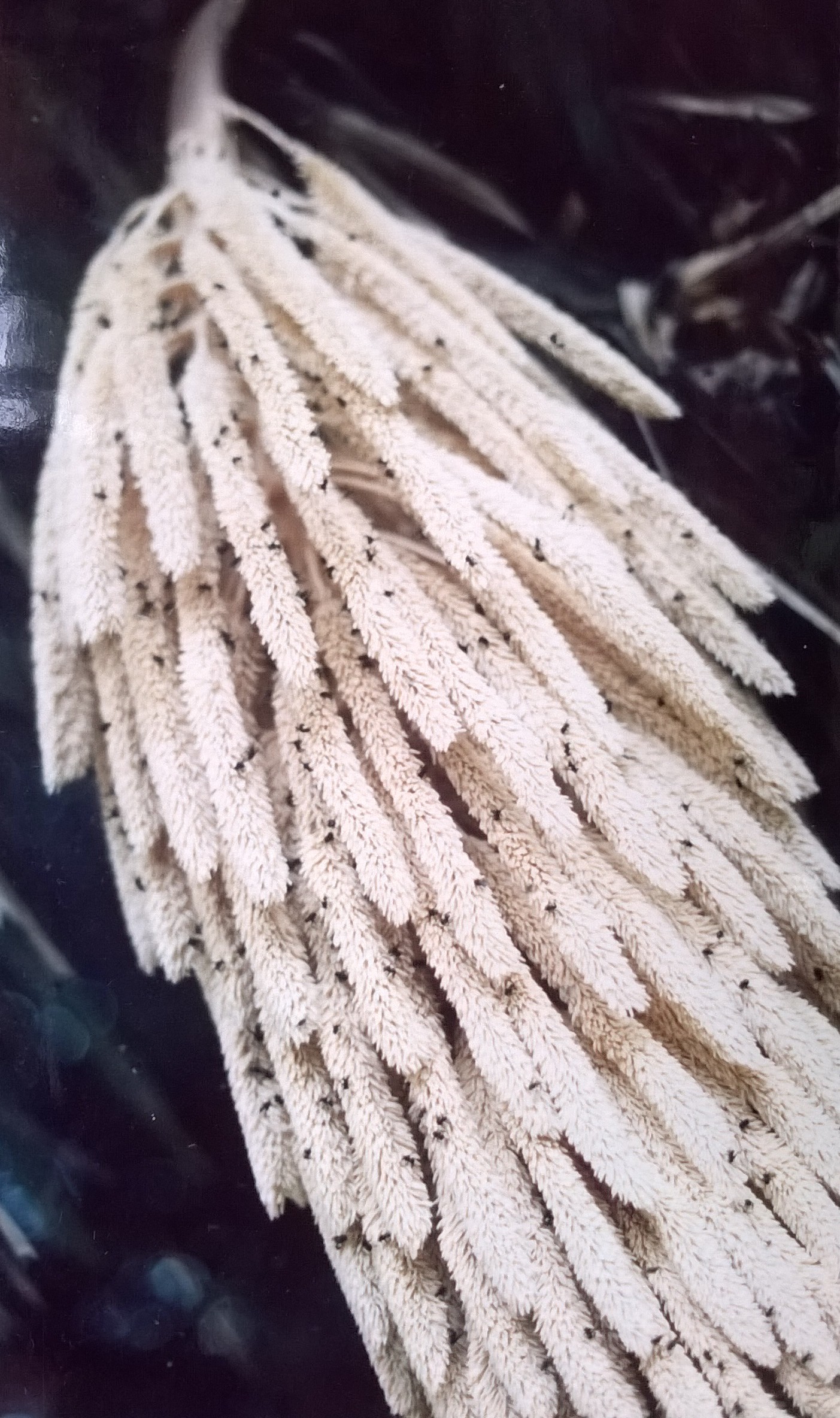
Flowers (1 cm) appear in huge racemes (1 m) that grow from in leaf axils. Initially protected by equally large, woody, boat-shaped coverts, the white racemes support a staggering number of rice-like (male) or three-petaled (female?) blossoms. A strong and pungent smell emanating from these racemes penetrates the humid forest air and is often the first clue that a fertile raceme is near. (This musty odor can be so omnipresent and persistent that it is often associated with the dank rainforest environment.) Flower racemes continue to appear over an extended period of time – though relatively infrequently – during the mid to late rainy season (from late June to November).
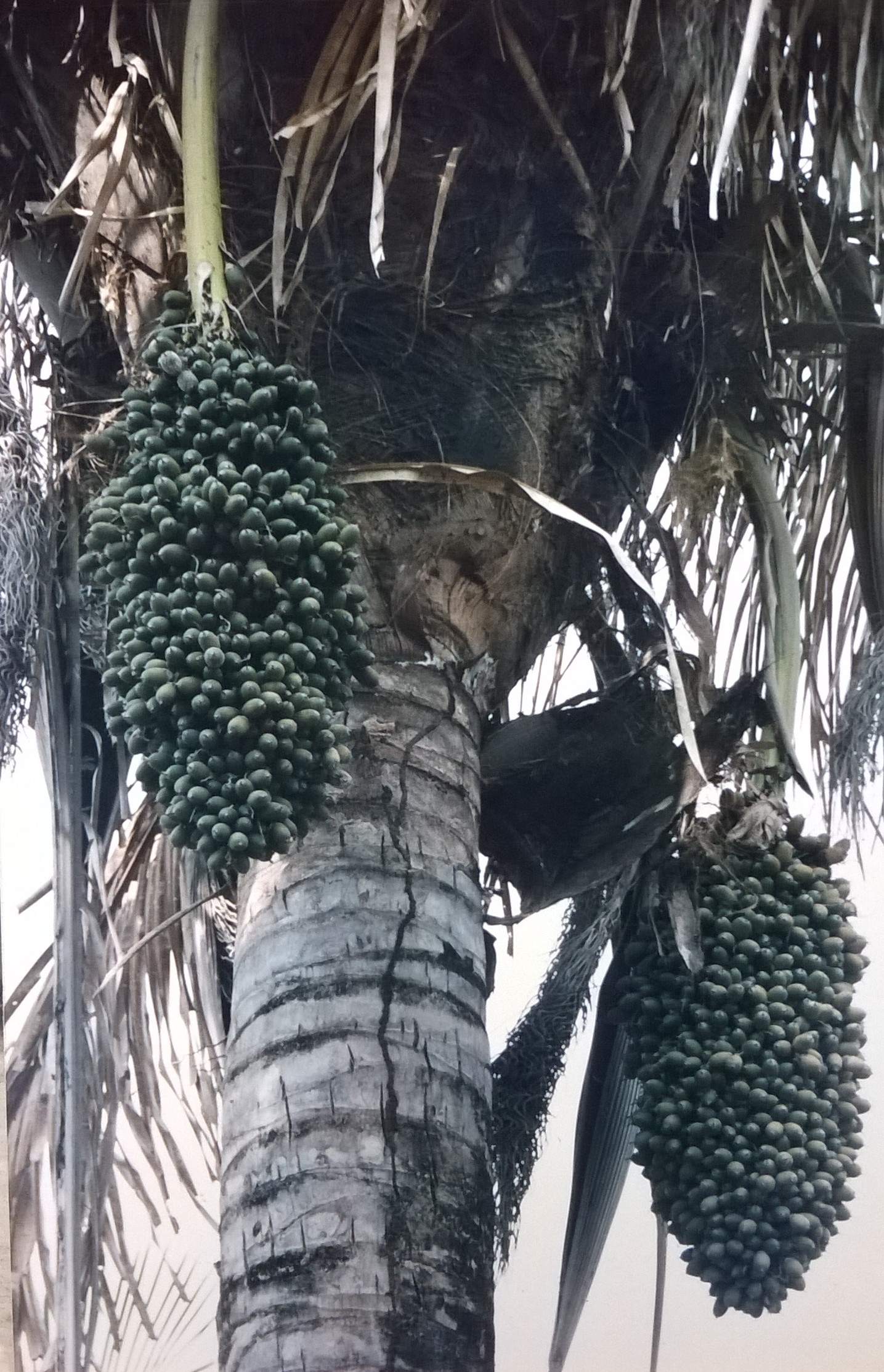
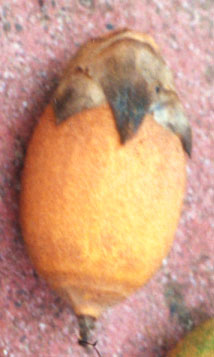
Soon after flowering, large numbers of fruits begin to thickly pack the same racemes. Each fruit is a sessile, ovoid drupe (4 by 2.5 cm) with a pronounced distal point and a large, star-shaped calyx located proximally. Ripening from green to a dull, yellow-brown or burnt-orange color, the fruit possesses a soft layer of mildly-sweet, rich, and greasy flesh underneath a thin, woody skin. A single, large, central seed fills the fruit core. Though these nuts reach full size within two months after flowering, ripening and harvest are delayed until the early part of the following rainy season. These heavy, pendulous racemes thus accumulate slowly during the later part of the rainy season, remaining dormant during the dry “summer” months. Ripening only commences in May, with the onset of the first heavy rains. Fruits continue to mature until August.
Similar Species: Palma Real is easily the largest palm in Manuel Antonio. Mature trees have crowns at least twice as wide as either of the other two large palms present here – the coconut palm (Cocos nucifera) and the Chontadura palm (Astrocaryum confertum). Furthermore, coconut palms are restricted to the sandy coast (where Palma Real is never found) and they have coconuts(!) while Chontadura palms have a thickly – and dangerously – spined trunk. In any case, Palma Real is distinctive because of its unusual, “rooster-tail” leaf arrangement.
Natural History: Palma Real flowers attract many pollinators with their potent, penetrating odor but the small, black, stingless “cuchuco” (Trigona sp.) bees are particularly common visitors. Fruits are eaten my many arboreal mammals, with pizotes and white-faced monkeys seen most frequently – harvesting drupes directly from the canopy.
Uses: Palma Real foliage has been and is used extensively in the construction of thatched roofs. If harvested at the correct time (with leaves being neither too old nor too young), roofs made out of this material can last for four years or more. The large fronds are split longitudinally, along the mid rib. Then they are positioned side by side and tied to rafters made of poles. Finally, the leaflets are woven together. Generally, roofs made of palm leaves must be quite steep to encourage the runoff of rainwater and to avoid seepage and leaks.
Palma Real fruits are edible and good-tasting, with a thick – almost dry – consistency, and a mildly sweet and nutty taste.
Distribution: In MANP, Palma Real is found in the understory of primary forests in Punta Catedral, where it is especially common along the last one-third of that trail. It is also – but less frequently – located along other park trails (including in disturbed, sunny sites) but is not found along the sandy coastline. In Costa Rica, Palma Real is a common component of the Pacific coastal vegetation. It is often seen growing solitarily (or in stands) in pastures, where it has been purposely left to provide fodder for cattle. Palma Real ranges from Nicaragua to Panama.
 Trees of Costa Rica's Pacific Slope