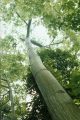
Garcinia intermedia (Pittier) Hammel
Clusiaceae JORCO
Tree: Occasional evergreen understory (10-20 m) tree found in most primary forest habitats, excluding the extreme coastal zone. This tree forms a densely branched, thick, and dark green crown that is sometimes adorned with contrasting, bright orange fruits.
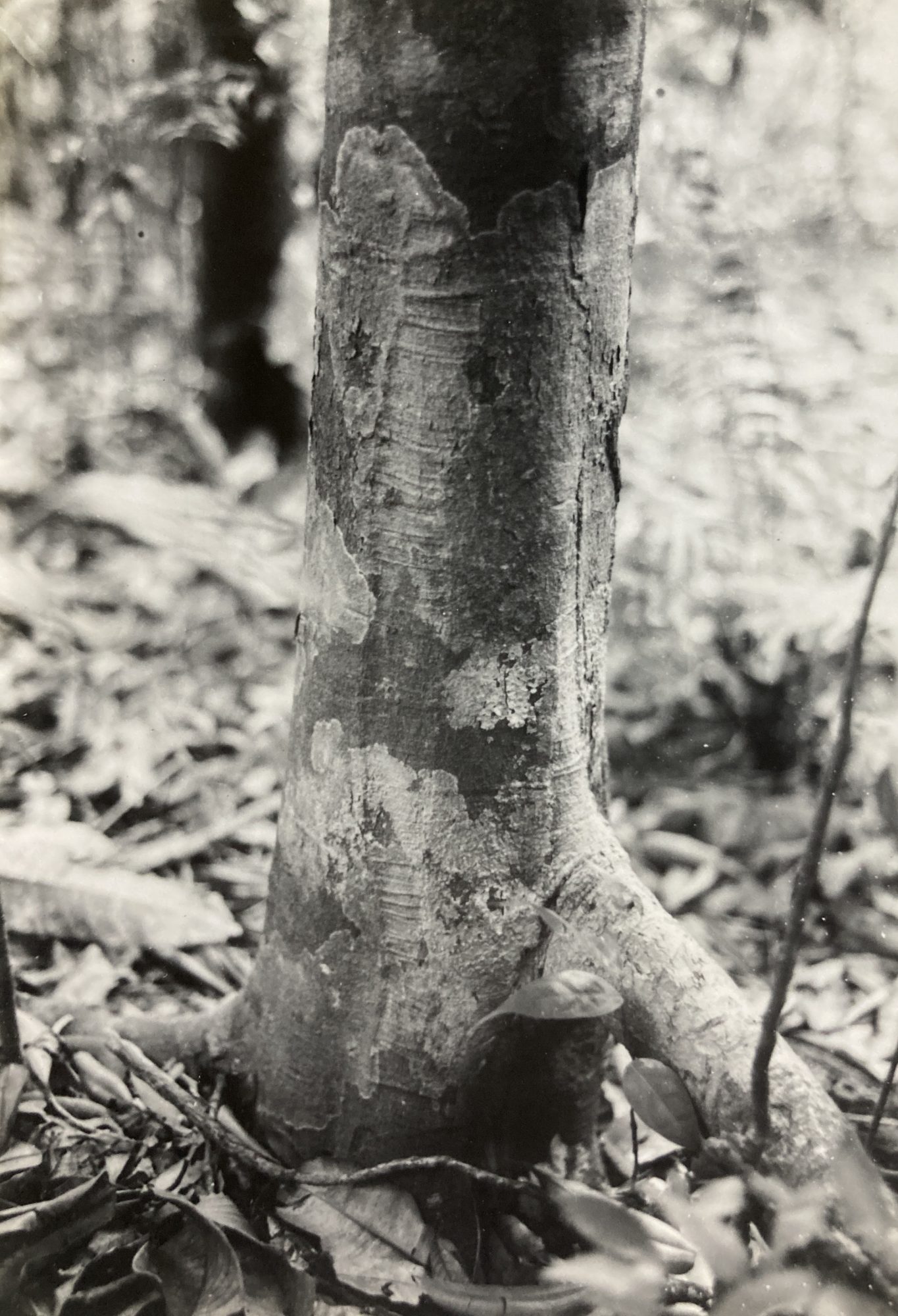
Description: Jorco has a cylindrical and straight trunk of small girth (20 cm). The brown-black bark is mostly smooth, though some low horizontal striations give it some texture. The upper half of the tree is thickly covered with thin, horizontal branches, oriented at right angles to the bole. This profusion of limbs, combined with an ample covering of dark green foliage, produces a dense, impenetrable crown – unusual in an understory species – though its pyramidal shape is typical of many monopodial trees. Leaves (8 by 3 cm) are simple and oppositely arranged. They are relatively thick and leathery, with smooth surfaces and entire margins. Elliptical in shape, the opaque, emerald green blades taper to points at both ends and include moderately well developed drip tips. The unique Garcinia petiole (1 cm) is formed from the union of the lower blade edges that curl around the midrib and are fused where they meet. As in other members of the Clusiaceae family, secondary leaf veins are fine and parallel. New leaves, usually grown just prior to flowering but potentially visible from November to April, are translucent and white or flesh-colored. Appearing at the tips of the branches, they stand out in marked contrast to the deep green hues of the rest of the crown.
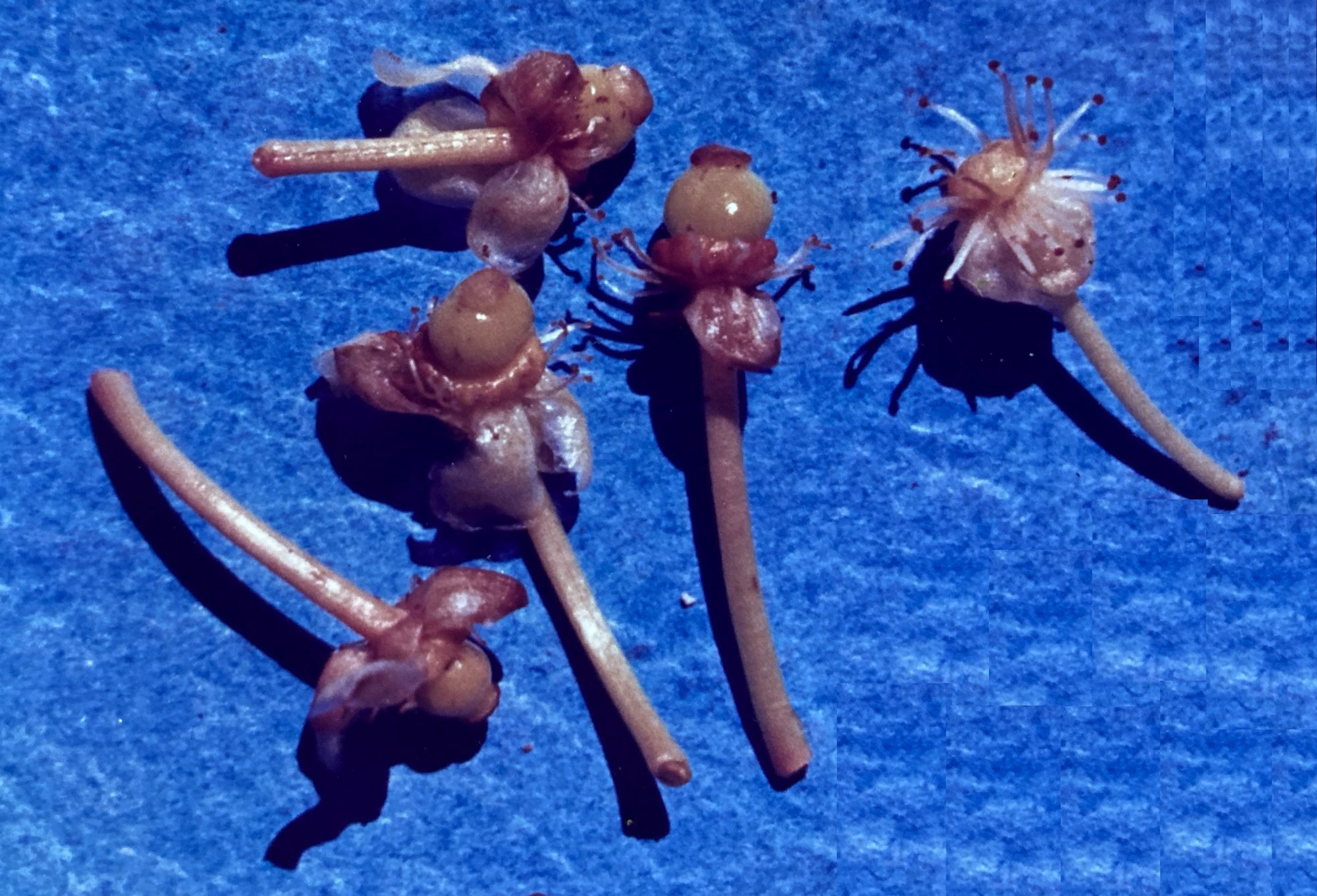
Flowers (5 mm) are imperfect, with male and female blossoms appearing on separate trees (dioecious). Both types of flowers are produced in compact and dense axillary clusters. Each blossom consists of five pale, greenish-white petals that are folded back around the pedestal and either a central, globular cluster of about 20 short stamens (male) or a globular green ovary topped with a brown stigma (female). Several vestigial staminate appendages are also present in the female flower. Blossoms are strongly and sweetly aromatic. Flowers may be seen for a short (three week) period occurring sometime between November and early January: the exact timing and the degree of synchronization of the event are quite variable.
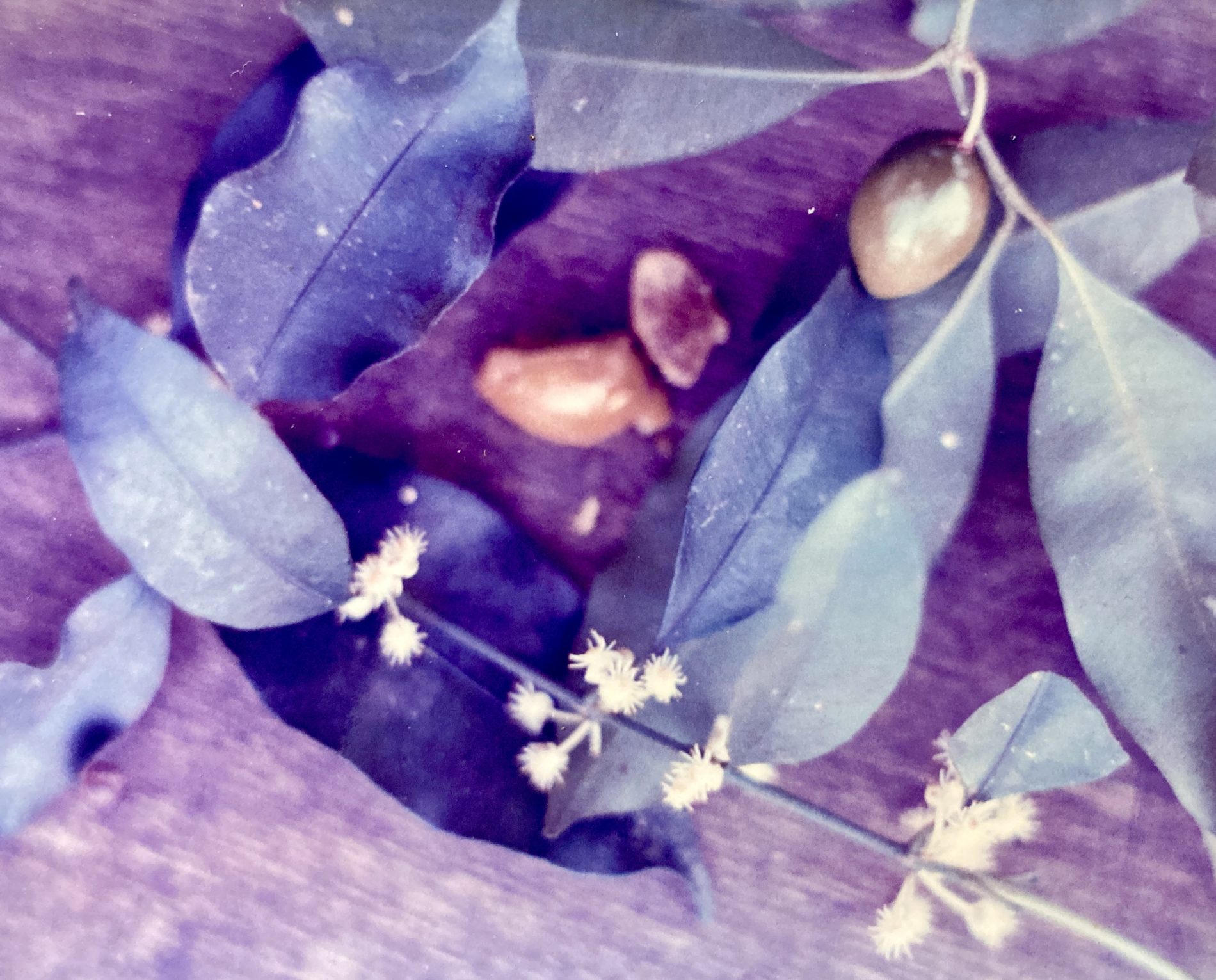
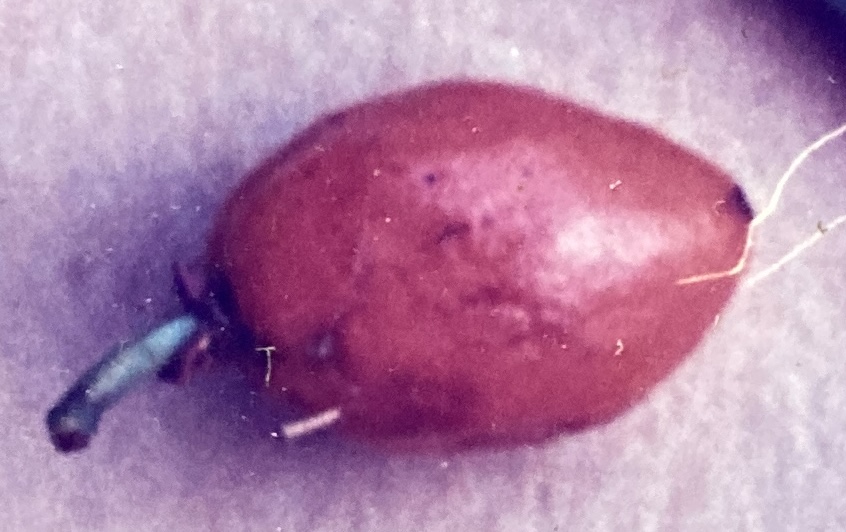
Fruits mature, changing color from glossy green to orange, as fleshy (2.5 cm) ovoid berries. Nestled amid the contrasting foliage, they can be seen dangling from flexible, short green stems. The fruit conceals a pair of almond-shaped seeds (2 cm), each bearing a flattened side marking its point of contact with the other. Harvests begin in late December and continue, slowly but continuously, through March. Seeds do not germinate immediately, waiting instead for several months – often well into the rainy season – before initiating growth.
Similar Species: Other understory trees with small, opposite leaves include Eugenia argyrea, and Myrciaria floribunda. These are distinguishable from Garcinia in two unmistakable ways. First, they lack the dense crown, monopodial trunk, and horizontal branching of Garcinia. Second, their leaves have netlike patterns of secondary veins while those of Garcinia are neatly parallel.
Natural History: Flowers are probably insect pollinated. Fruits are highly prized by birds and mammals alike: squirrel monkeys, Buff-throated Saltators and bats (Croat, 1978) are among the animals that have been observed eating them.
This tree is extremely easy to recognize when new leaves are present – the pairs of white blades stand out in marked contrast from the rest of the foliage. Possibly, the practice of producing young leaves without chlorophyll is an adaptation designed to help plants conserve nutrients in an environment where they are scarce and competition for them is keen. Young, tender leaves are more palatable and are highly prized by rain forest mammals and insects. Reserving the nutrient-rich chemical chlorophyll from them at a time when they are most vulnerable to parasitism helps the plant protect itself against nutrient loss.
Distribution: In MANP, Garcinia grows in all primary forest habitats except for those very near the coast. It ranges from Mexico to Peru.
 Trees of Costa Rica's Pacific Slope