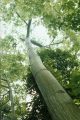
Almendro de la Playa, Indian Almond
Combretaceae
Locally common evergreen or briefly deciduous canopy tree (20-25 m) found growing exclusively within the narrow fringe of vegetation that borders the sandy coastline. Almendro is an introduced species, originally native to India, that has been naturalized and now grows wild along many Costa Rican beaches. Able to withstand the harsh sunlight, salty air and drought prone soils typical of this habitat, the tree has proven itself to be an aggressive competitor: reproducing rapidly and forming stands whose dense shade inhibits the growth of native vegetation.
Description: Large Almendro trees usually have bent or inclined trunks (35 cm), thanks in part to the high winds and loose substrate that they are subjected to along the coast, but also due to their tendency to grow toward the open ocean, where sunlight is most abundant. Moderately irregular as well, boles possess shallow folds and occasional knobs or burls that mark the location of fallen branches. The bark is tan colored and rough. Since the canopy of the coastal forest is relatively open, high levels of insolation are able to penetrate to the soil, encouraging even large Almendro trees to maintain branches along their entire lengths. These limbs – relatively few in number – emerge at right angles to the boles and continue to grow horizontally as leaves are added each season. New twigs extend laterally in repetitive, upwardly-concave arcs, mimicking a growth pattern typical of the Combretaceae at large. Particularly evident in smaller Almendro saplings (up about 15 m in height), branches are often arranged in discreet whorls, with five or six limbs emerging simultaneously from periodic nodes along the trunk.
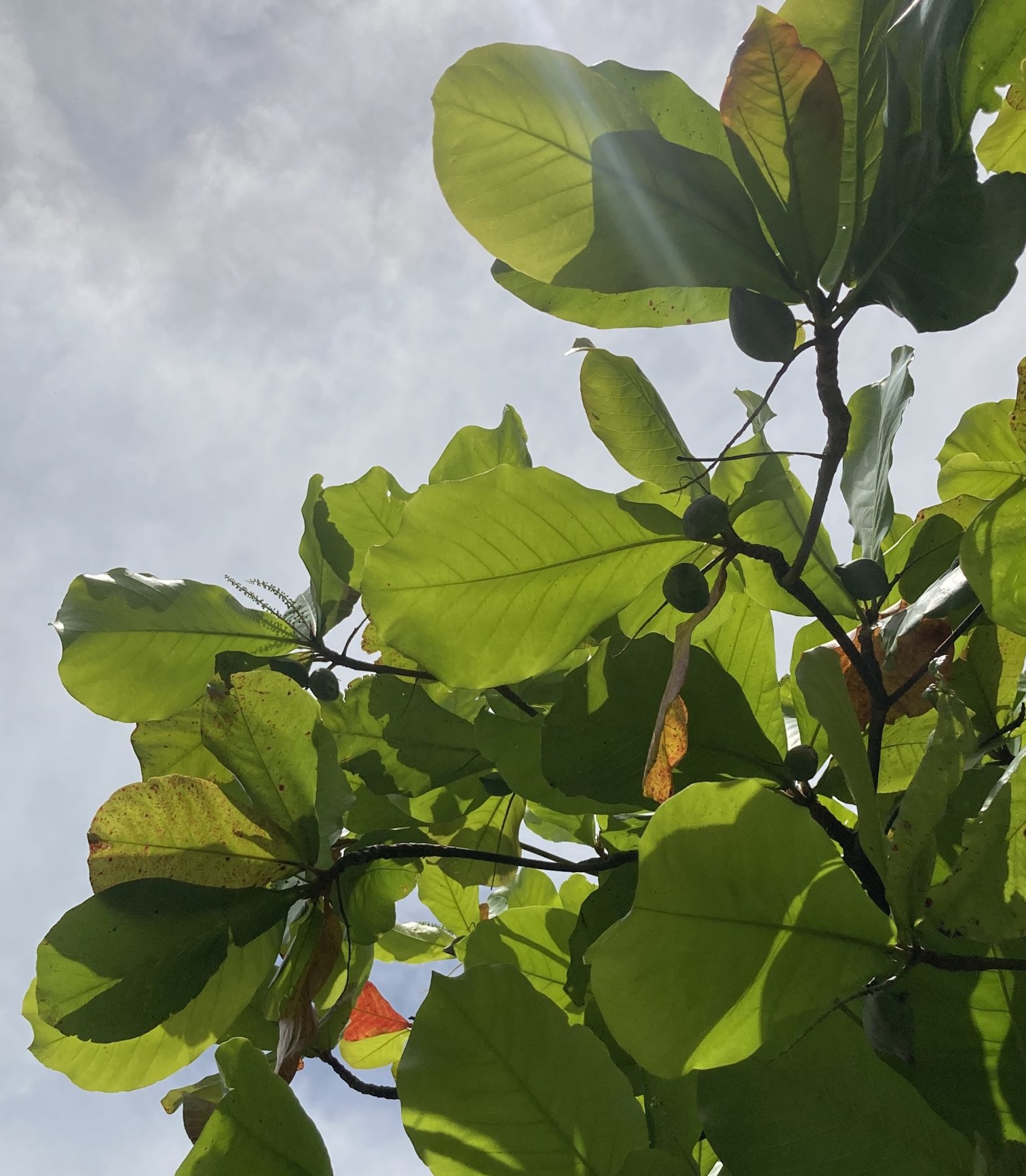
The crowns of such small trees appear to be made up of thick, parallel sheets of foliage – especially when viewed from a distance. Older Almendro crowns are narrow and densely packed with large leaves that permit little direct sunlight to reach the ground. Almendro leaves are unusually big (21 by 13 cm), simple, and alternately arranged. The broadly elliptical or spatulate blades are entire and quite smooth, with some golden pubescence present on the undersides of the yellow veins and on the petioles (1.5 cm). The blades are organized in whorl-like clusters, concentrated at the tips of the twigs. In an unsynchronized, random event occurring sometime between September and March, Almendro leaves turn bright red, are completely shed, and regenerate, with trees remaining leafless only briefly.
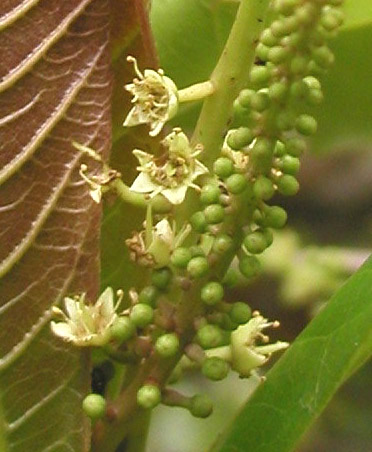
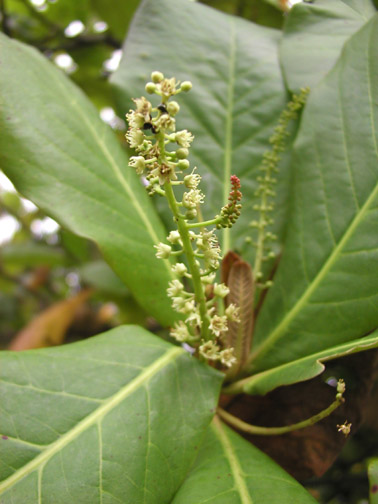
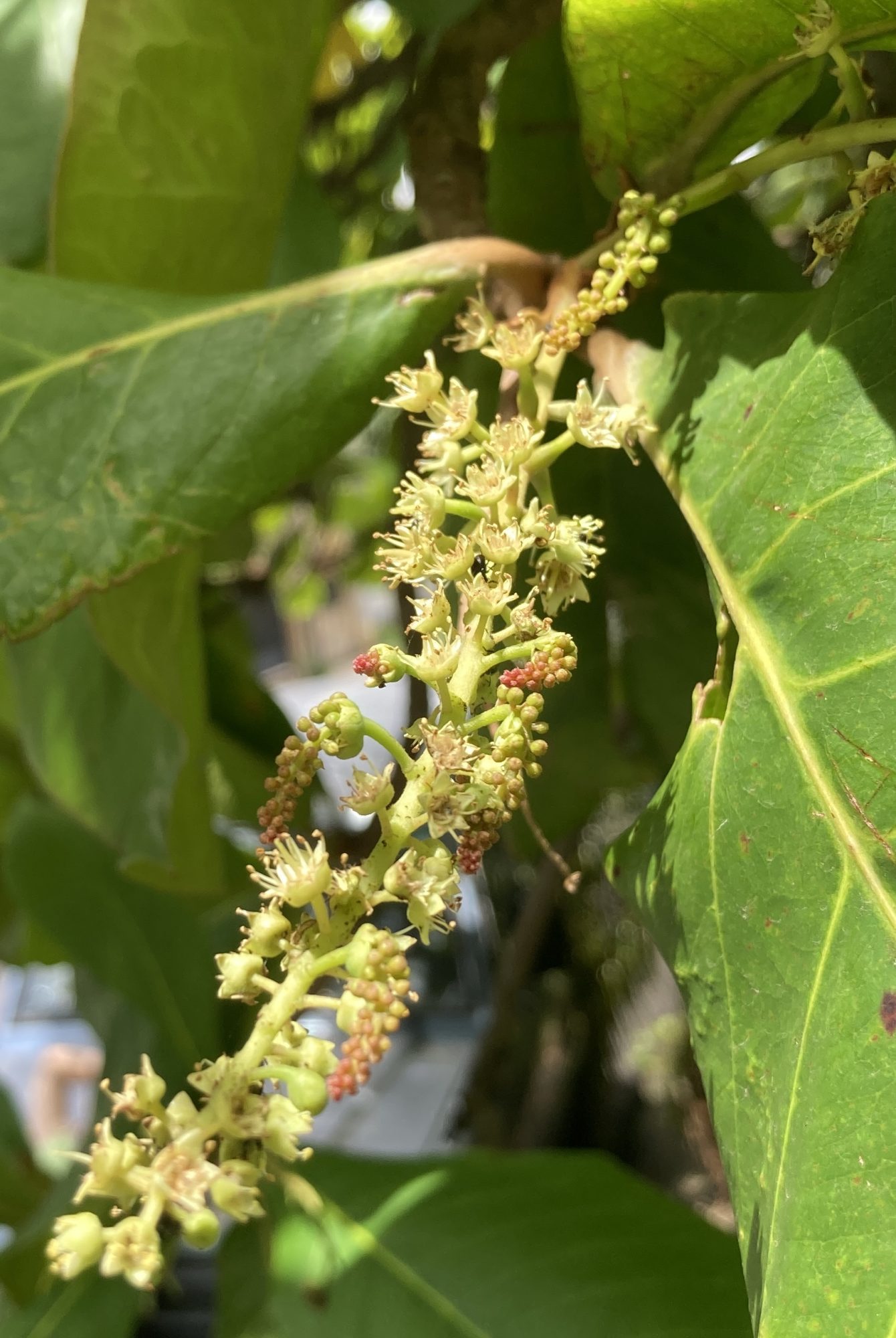
Almendro trees are andromonoecious (Atluri et al) – bearing separate male and bisexual flowers (6 mm) on the same spike-like racemes (20cm). Both types of blossoms are petal-less. Located distally, the more numerous male blossoms are each composed of five green sepals (arranged into a five-pointed star); five, basally positioned, reddish nectar glands; and ten, short stamens. Bisexual flowers, numbering four or five per raceme and occupying its base, are distinguished by their longer, swollen pedestals and well-developed pistils – though they too carry 10 anthers. Flowers are visible all year on Almendro trees, but there is a marked peak in flowering activity during the weeks following crown renewal and in the early rainy season months of April through July. Fruits develop from the enlarging female flower pedestals, located proximally along the spike. Measuring 6 cm by 4 cm, each is a somewhat flattened, ovoid drupe, sporting a thin, encircling, lateral lip or apron. Maturing from green to yellow, a thick layer of fibrous, edible flesh surrounds a single, almond-shaped seed (2.5 cm by 1 cm). Harvest continues all year long, with a slight peak in activity observable during the dry summer months of March and April. Seeds germinate easily in the sandy soil, fairly soon after fruit fall. Growing along the beaches, emerging seedlings are easily recognizable for their spirally wound seed leaves that later unravel into a pairs of opposing, ovoid blades.
Similar Species: For its site specificity, large, broad foliage, and omnipresent flowers and fruits, Almendro may be identified with precision.
Natural History: Almendro flowers are pollinated by insects. Its fruits are eaten by a variety of animals, including scarlet macaws and bats. Almendros are well adapted to the harsh conditions of the salty coastline, where they thrive – even to the unhappy exclusion of native flora. Fortunately, they do not seem to be able to compete in the deeper forest environment, where the darkness of the shaded understory seems to preclude their survival. Though bats effectively disperse Almendro seeds, and eaten fruits accumulate under specific roosting branches of the interior forest, no seedling has yet been observed to take hold there.
Uses: Almendro trees are popular as ornamentals. One of the few arboreal species adapted for survival along the beach, Almendros provide year-round shade – and welcome relief from the tropical sun. In addition, Almendro leaves are known to possess significant quantities of chemicals such as tannins and flavonoids that have medicinal and other uses. In particular, the former chemical can be used to reduce corrosion in metals. The lack of growth underneath Almendro crowns where leaves accumulate has been attributed to the high concentration of these substances as well.
Distribution: In MANP, the Almendro is limited to the sandy environment fringing the park’s main beaches. Originally native to Southeast Asia, Almendros have been introduced and naturalized worldwide, and now enjoy pantropical distribution.
 Trees of Costa Rica's Pacific Slope