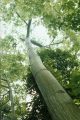
Xylosma intermedia (Seem.) Triana & Planch.
Flacourtiaceae
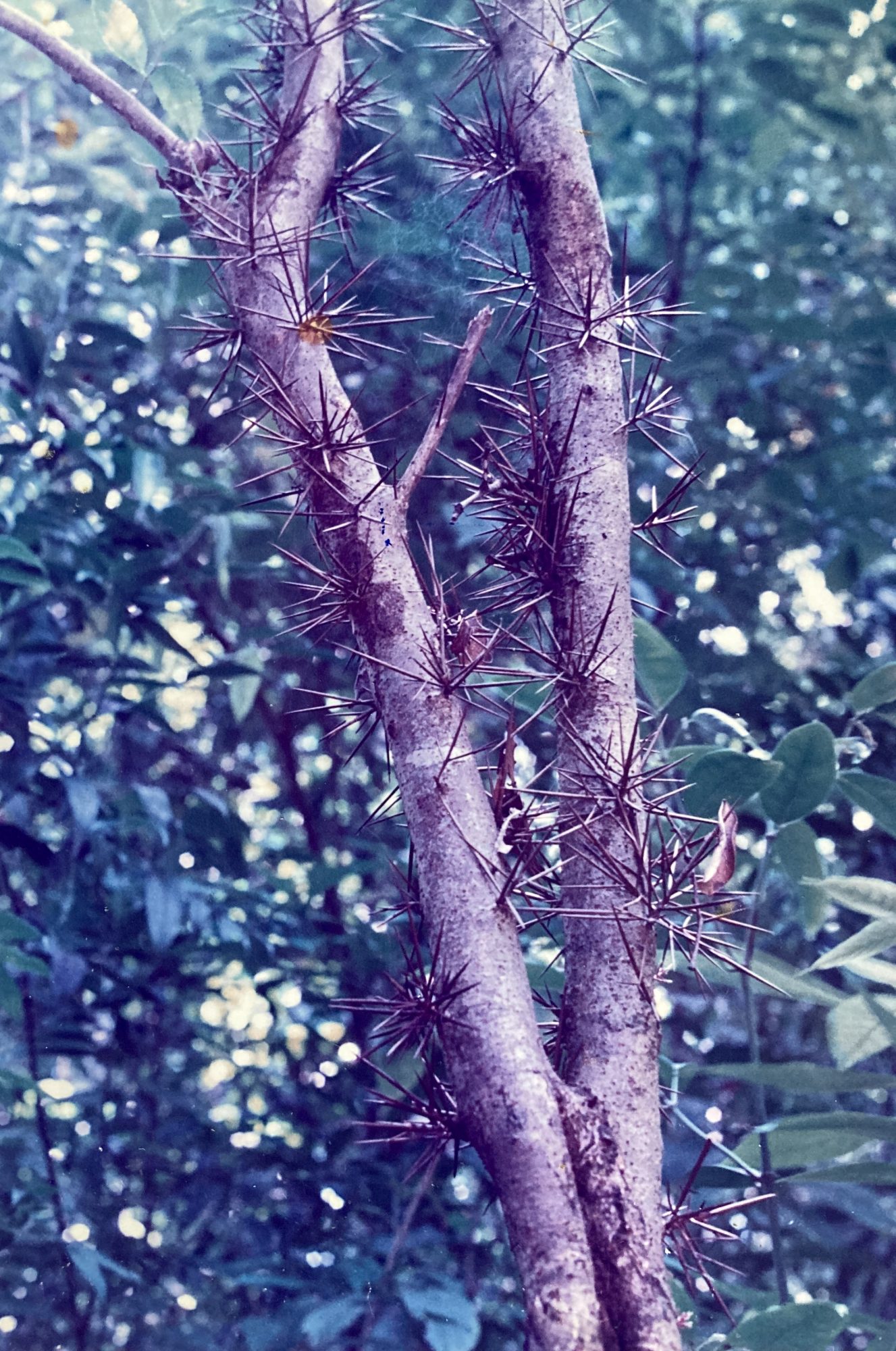
Occasional understory (5-15 m) evergreen tree or treelet found in light gaps along trails and in thin, well illuminated (often drier) woods. This species is notable for the daunting array of fiercely piercing spikes that cloak its bole.
Description: Xylosma has a cylindrical trunk that can reach a maximum diameter of 25 cm, though most individuals are only about half this size. The bark is gray, smooth, and contains numerous point lenticels. Branches are few in number and the crown they produce is thin and narrow. Xylosma twigs are brown and also present point lenticels. By far the most striking and intriguing trunk characteristic is the heavy armor that protects it: large (10 cm), multi-tiered arrays of long, tapering and needle-sharp spines line the lower bole. In August, new spines grow out of the bark (emerging in much the same way that new leaves appear from the twigs). They begin in small, red bundles and slowly expand into green, flexible spines that finally brown and stiffen by November.
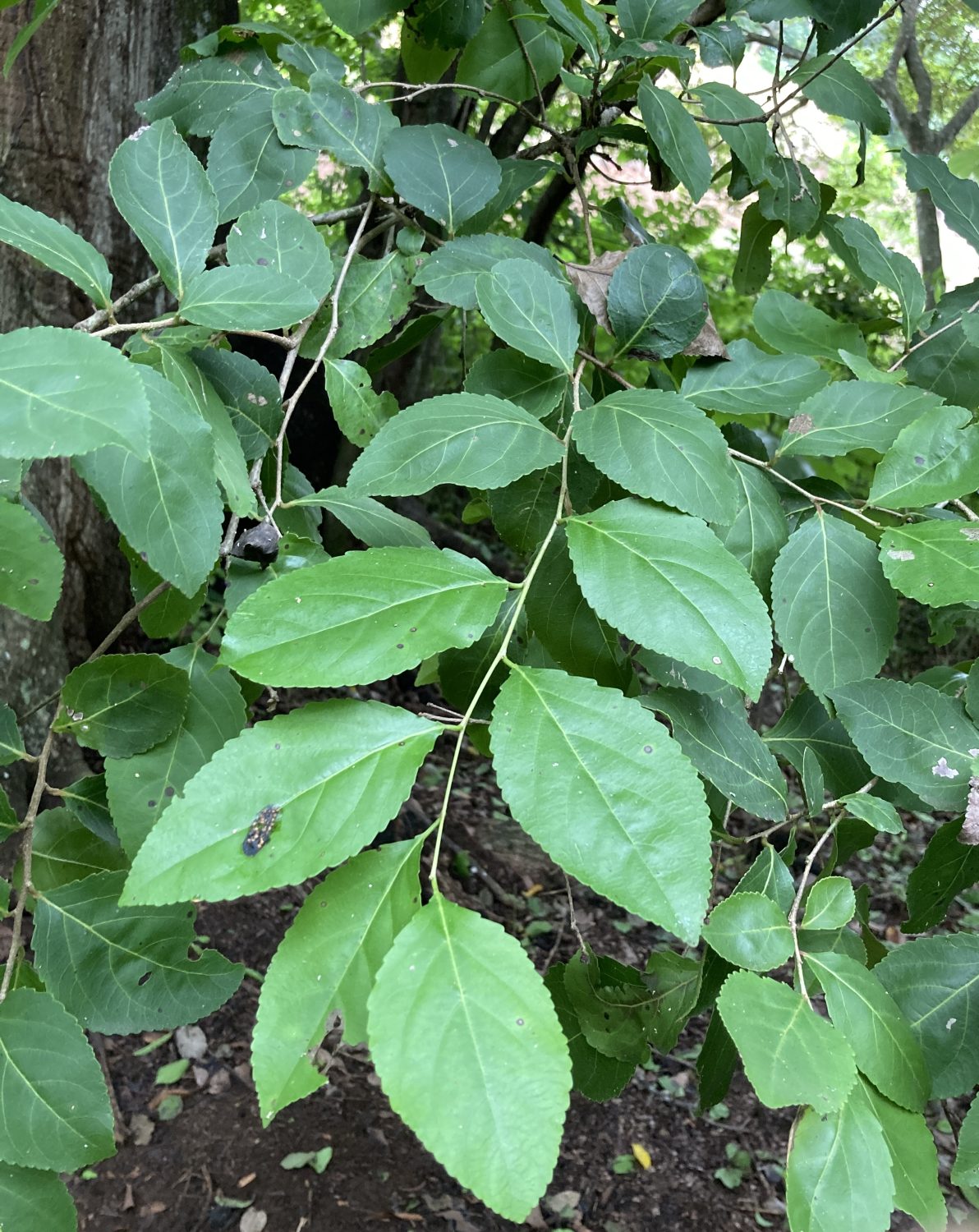
Leaves are simple, alternate, and variable in size, ranging from 10-17 cm in length and from 3-4.5 cm in width. The smooth blades are usually very narrowly elliptical in shape, though when smaller they tend to be wider and more rounded. All leaves end in long, slowly-tapering drip-tips and short (0.5 cm) petioles. Deeply serrate margins border the blades and this obvious and relatively unusual feature facilitates the identification of this species. Foliage is shed in March and Xylosma trees remain completely bare for the following month.
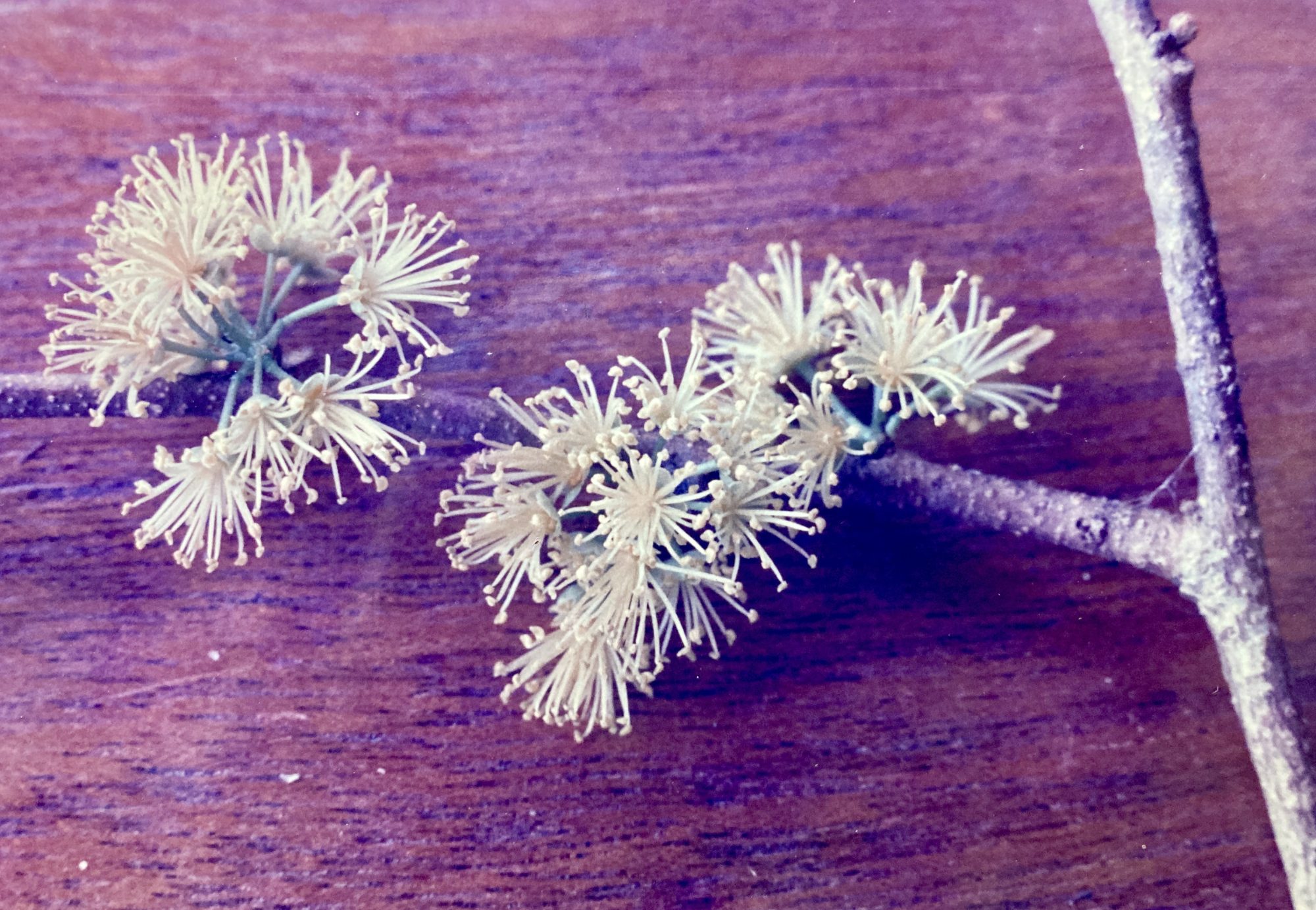
During this deciduous period, flowers appear in short, dense, racemes from the empty leaf axils. Dioecious, Xylosma sports imperfect blossoms with male and female flowers occurring on separate trees. Lacking petals, the small male blossoms (6 mm) are dominated by fifteen relatively long, yellowish stamens and a bright orange nectar disk (to which they are attached). Five minute, green sepals are also present. Flowering occurs sporadically and for short periods from mid-February through early April.
Fruits appear within a few weeks of the flowers on female trees and mature as nearly globular, orange berries (1 cm) with slightly pointed tips. Each contains about five small seeds. Harvests are short-lived events that occur sometime between late March and mid-May.
Similar Species: No other tree of this stature sports such complex arrays of spines on its bole. Xylosma‘s deeply serrate leaves are nearly as unique. Taken together, these two characteristics ensure the definitive identification of even sterile Xylosma individuals.
Natural History: Xylosma‘s simple flowers are pollinated by bees while its fruits are probably bird dispersed. What might otherwise be a muted and insignificant floral display is made noteworthy and memorable by its coincidence with tree defoliation. The thin, bare branches become adorned with fuzzy, yellow clusters of blossoms, creating an eye-catching and unusual tropical forest sight. Undoubtedly, the temporal coordination of fertility with deciduousness confers an adaptive advantage to this species by making Xylosma flowers more conspicuous to pollinators (as well as to people). Xylosma‘s unusual spines are probably derived from modified leaves (something that is usually true for flowers as well), thus explaining their leaf-like generation. Hypothetically, they provide protection from climbing leaf and fruit eating mammals such as pizotes and raccoons.
Uses: An herbarium note suggests that indigenous peoples used the latex of this species as a treatment for making molars loosen and fall from the gums.
Distribution: In MANP, Xylosma intermedia is found in well-lit sections of forest and along the Puerto Escondido and Lutz Road trails as well as in Punta Quepos. It ranges from Mexico to Brazil.
 Trees of Costa Rica's Pacific Slope